how to divide fractions mastering key steps and real world uses
Table of Contents
- Understanding the Basics of Fractions: Foundations for Division
- Components of Fractions: Numerators, Denominators, and Their Roles
- How Fractions Represent Parts of a Whole: Visualization and Analogies
- Comparing Fractions, Decimals, and Percentages: Interconnections and Applications
- Converting Mixed Numbers and Improper Fractions: Step-by-Step Methods
- The Concept of Dividing Fractions: Mathematical Logic and Historical Evolution
- Algebraic Proof of the Invert-and-Multiply Rule
- Historical Development of Fractional Division
- Dividing Fractions vs. Dividing Whole Numbers: Key Differences
- Real-World Applications of Fractional Division
- Geometric Interpretation of Fractional Division
- Common Division Problems and Step-by-Step Solutions
- Mastering Fraction Division: A Practical Step-by-Step Approach
- Step-by-Step Procedure for Dividing Fractions
- Handling Mixed Numbers in Fraction Division
- Simplifying Fractions Before and After Division
- Advanced Techniques and Special Cases in Fraction Division
- Division of Fractions with Negative Numbers
- Dividing Fractions with Variables
- Dividing Complex Fractions
- Word Problems Involving Fraction Division
- Special Cases in Fraction Division
- Practical Applications of Dividing Fractions in Daily Life and Professional Fields
- Culinary Arts: Precision in Adjusting Recipes and Ingredient Quantities
- Work Rate Calculations in Engineering and Labor Distribution
- Financial Mathematics: Splitting Assets, Interest Rates, and Proportional Allocations
- Trades and Craftsmanship: Fractional Measurements in Design and Material Allocation
- Data Analysis: Fractional Percentages and Survey Interpretation
- Educational Methodologies: Teaching Fraction Division Across Curricula
- Common Challenges and Strategies for Mastering Fraction Division
- Frequent Mistakes and Their Root Causes in Fraction Division
- Strategies to Overcome Division Challenges: Mnemonics and Visual Learning
- Breaking Down Complex Problems: Decomposition and Alternative Methods
- Word Problem Translation: Red Flag Phrases and Mathematical Conversion
- Handling Unlike Denominators and Systematic Debugging
- Resources for Additional Practice and Support
Fractions often intimidate learners, yet mastering their division unlocks solutions to everyday problems—from adjusting recipe ingredients to calculating precise measurements in construction. Unlike whole numbers, fractions demand a unique approach, where dividing by a fraction actually means multiplying by its reciprocal, flipping a fundamental rule most encounter early in math education. This method, rooted in ancient mathematical principles, transforms complexity into a systematic process once its logic is understood.
Historically, civilizations from Egypt to Greece grappled with fractional divisions to measure land, distribute resources, and solve architectural challenges. Today, the same principles apply in modern fields like engineering, finance, and even culinary arts. Whether splitting a pizza among uneven slices or determining how long a machine operates based on fractional fuel consumption, dividing fractions bridges abstract theory with practical necessity. Yet, missteps—like flipping the wrong fraction or neglecting simplification—can turn straightforward calculations into frustrating errors. This guide dismantles those barriers, offering clear steps, visual aids, and real-world applications to demystify the process.
Understanding the Basics of Fractions: Foundations for Division
Fractions are the building blocks of division in mathematics, representing quantities that are less than a whole or larger than one through proportional parts. Mastering their fundamental components—such as numerators, denominators, and their classifications—is essential for solving real-world problems, from splitting a pizza among friends to calculating precise measurements in engineering. This section explores the core elements of fractions, their visual and practical applications, and their relationships with decimals and percentages, ensuring clarity through structured definitions, analogies, and interactive thought experiments.
Components of Fractions: Numerators, Denominators, and Their Roles
A fraction consists of two primary components: the numerator (top number) and the denominator (bottom number). The numerator indicates the number of equal parts being considered, while the denominator specifies how many equal parts the whole is divided into. For example, in the fraction 3/4, the numerator 3 represents three slices of a pizza, and the denominator 4 shows that the pizza is divided into four equal slices.
Visualizing fractions enhances comprehension. Below is a comparison table illustrating how numerators and denominators interact in different contexts:
| Fraction Type | Numerator | Denominator | Visual Representation | Real-World Example |
|---|---|---|---|---|
| Proper Fraction | Smaller than denominator | Greater than numerator |
(2/5 of a circle shaded) |
Two out of five slices of a pie. |
| Improper Fraction | Equal to or larger than denominator | Smaller than or equal to numerator |
(7/3 of a rectangle, where 2 full rectangles + 1/3 are shown) |
Seven-thirds of a cake (equivalent to 2 full cakes and 1/3). |
| Mixed Number | Whole number + proper fraction | Same as fraction’s denominator |
(3 2/4 or 3 ½) |
Three and a half hours (3 + ½). |
Understanding these components is critical for accurate division, as fractions inherently involve partitioning a whole into equal shares. For instance, dividing a chocolate bar into 8 equal pieces and taking 3 pieces translates to the fraction 3/8, where the denominator (8) defines the total divisions, and the numerator (3) specifies the selected portions.
How Fractions Represent Parts of a Whole: Visualization and Analogies
Fractions describe division by partitioning a whole into equal segments. To solidify this concept, consider the following thought experiment:
1. Divide a Whole into Equal Parts: Imagine a pizza cut into 6 equal slices. Each slice represents 1/6 of the pizza. If you eat 2 slices, you’ve consumed 2/6 (or simplified, 1/3) of the pizza. 2. Scaling the Division: Now, divide the same pizza into 12 slices. Each slice is now 1/12 of the pizza. Eating 4 slices means 4/12 (1/3) of the pizza remains, demonstrating how denominators affect the size of each part. 3. Real-World Application: Time is another practical example. An hour divided into 60 minutes means each minute is 1/60 of an hour. If a task takes 15 minutes, it occupies 15/60 (1/4) of an hour.
This visualization underscores that fractions are a direct representation of division. The denominator acts as the divisor, while the numerator is the dividend. For example, dividing 5 by 2 yields 5/2, an improper fraction indicating two full wholes (4) plus an additional 1/2.
Comparing Fractions, Decimals, and Percentages: Interconnections and Applications
Fractions, decimals, and percentages are interconnected representations of division, each suited to specific contexts. Below is a breakdown of their relationships and practical uses:
| Representation | Definition | When to Use | Conversion Example |
|---|---|---|---|
| Fraction | A ratio of two integers (numerator/denominator). | Exact divisions (e.g., recipes, measurements). |
3/4 = 0.75 (decimal) = 75% (percentage) |
| Decimal | A base-10 numerical system using a decimal point. | Financial calculations, scientific measurements. |
0.6 = 3/5 (fraction) = 60% (percentage) |
| Percentage | A fraction of 100 (per centum). | Statistical data, interest rates, discounts. |
40% = 2/5 (fraction) = 0.4 (decimal) |
Key Insight: All three forms derive from division. For instance, dividing 3 by 4 yields the fraction 3/4, which converts to the decimal 0.75 and the percentage 75%. Understanding these conversions is vital for interpreting data across disciplines, such as calculating 20% off a $50 item (0.20 × 50 = $10 discount) or measuring 1.5 meters (3/2 meters).
Converting Mixed Numbers and Improper Fractions: Step-by-Step Methods
Mixed numbers (e.g., 2 ½) and improper fractions (e.g., 5/2) are interchangeable forms. Converting between them simplifies complex calculations. Below are structured methods with examples:
Converting Mixed Numbers to Improper Fractions: 1. Multiply the whole number by the denominator. 2. Add the numerator to the result. 3. Place the sum over the original denominator. Example: 2 ½ → (2 × 2) + 1 = 5/2.
Converting Improper Fractions to Mixed Numbers: 1. Divide the numerator by the denominator to find the whole number. 2. The remainder becomes the new numerator. Example: 11/3 → 3 × 3 = 9 (whole number), remainder 2 → 3 2/3.
| Mixed Number | Improper Fraction | Calculation | |||||||||||||||||||||||||||||||||||||||||||||||||||||||||||||||||||||||||||||||||||||||||||||||||||||||||||||||||||||||||||||
|---|---|---|---|---|---|---|---|---|---|---|---|---|---|---|---|---|---|---|---|---|---|---|---|---|---|---|---|---|---|---|---|---|---|---|---|---|---|---|---|---|---|---|---|---|---|---|---|---|---|---|---|---|---|---|---|---|---|---|---|---|---|---|---|---|---|---|---|---|---|---|---|---|---|---|---|---|---|---|---|---|---|---|---|---|---|---|---|---|---|---|---|---|---|---|---|---|---|---|---|---|---|---|---|---|---|---|---|---|---|---|---|---|---|---|---|---|---|---|---|---|---|---|---|---|---|---|---|
| 1 ¾ | 7/4 | (1 × 4) + 3 = 7/4 | |||||||||||||||||||||||||||||||||||||||||||||||||||||||||||||||||||||||||||||||||||||||||||||||||||||||||||||||||||||||||||||
| 4 1/5 | 21/5 | (4 × 5) + 1 = 21/5 | |||||||||||||||||||||||||||||||||||||||||||||||||||||||||||||||||||||||||||||||||||||||||||||||||||||||||||||||||||||||||||||
| 13/4 | 3 1/4 | 4 × 3 = 12, remainder 1 → 3 1/4 | |||||||||||||||||||||||||||||||||||||||||||||||||||||||||||||||||||||||||||||||||||||||||||||||||||||||||||||||||||||||||||||
| 22/6 | 3 4/6 (or 3 2/3) | 6
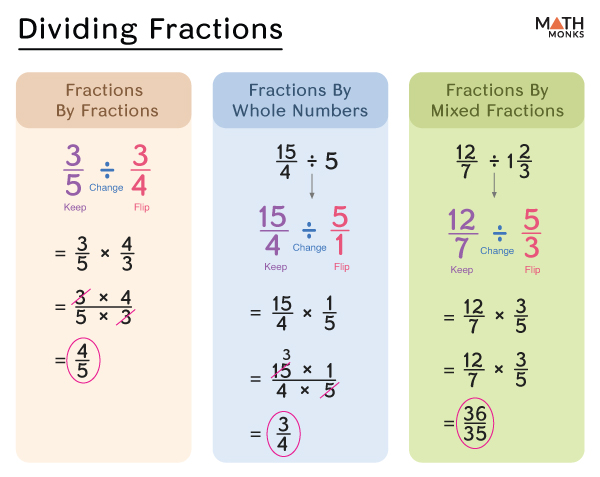
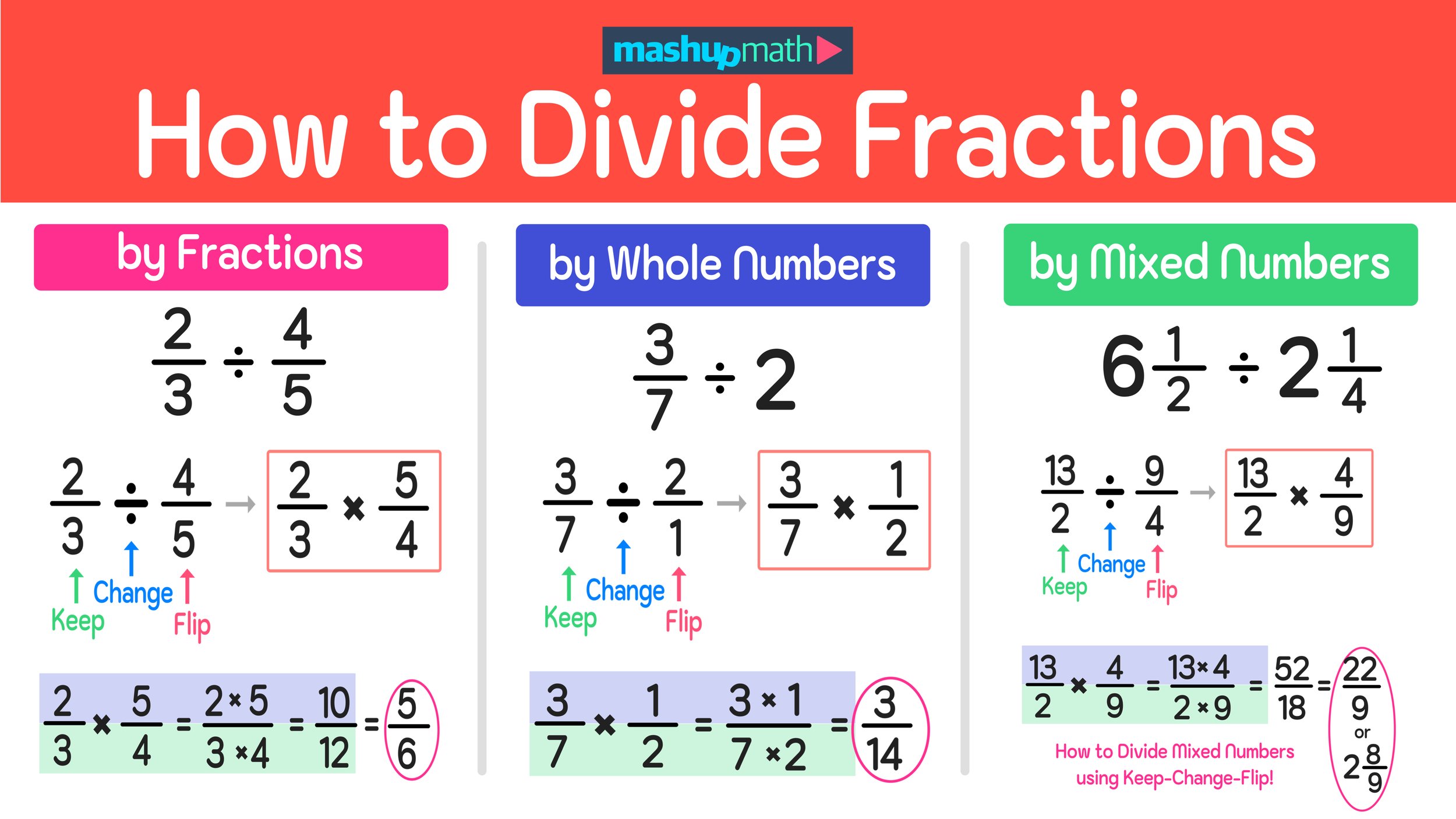
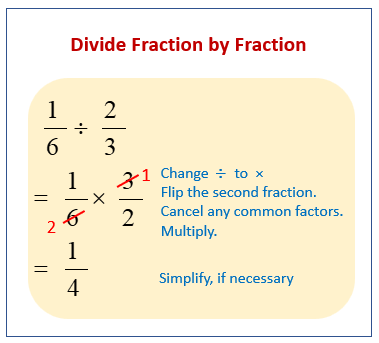
The Concept of Dividing Fractions: Mathematical Logic and Historical EvolutionUnderstanding why dividing fractions follows the "invert-and-multiply" rule often puzzles learners, yet its mathematical foundation lies in algebraic equivalence and the properties of rational numbers. The method of multiplying by the reciprocal isn’t arbitrary; it emerges from the need to maintain equality in equations involving fractions. Historically, fractional division evolved through practical necessity—from ancient Egyptian scribes solving land distribution problems to Greek mathematicians formalizing ratios. This section explores the algebraic proof behind the rule, its historical development, and its distinctions from whole-number division, alongside real-world applications that demonstrate its relevance.Algebraic Proof of the Invert-and-Multiply RuleThe core of dividing fractions hinges on the relationship between division and multiplication. When solving an equation like \( \frac{a}{b} \div \frac{c}{d} \), the operation can be rewritten using the definition of division as multiplication by the reciprocal. Algebraically, dividing by a fraction \( \frac{c}{d} \) is equivalent to multiplying by \( \frac{d}{c} \), because: \[ \frac{a}{b} \div \frac{c}{d} = \frac{a}{b} \times \frac{d}{c} = \frac{a \times d}{b \times c} \] This transformation preserves the equation’s integrity by leveraging the multiplicative inverse property: any non-zero number multiplied by its reciprocal equals 1. For example, \( \frac{3}{4} \div \frac{2}{5} \) becomes \( \frac{3}{4} \times \frac{5}{2} \), simplifying to \( \frac{15}{8} \). The rule ensures that the original division problem is solved without altering its fundamental meaning—only its operational form changes.Historical Development of Fractional DivisionThe concept of dividing fractions traces back to ancient civilizations where practical problems demanded precise measurements. The Egyptians (c. 1650 BCE), documented in the Rhind Mathematical Papyrus, used unit fractions (fractions with numerator 1) and relied on a form of reciprocal multiplication to solve division problems. Their method involved decomposing fractions into sums of unit fractions, a precursor to modern techniques. Meanwhile, Greek mathematicians like Euclid formalized ratios and proportions, laying groundwork for systematic fractional operations. The "invert-and-multiply" rule as we know it crystallized during the Renaissance, as mathematicians like Fibonacci in his Liber Abaci (1202) standardized fractional arithmetic for merchants and scholars. A key shift occurred when René Descartes and later Isaac Newton refined algebraic notation, making reciprocal multiplication the standard for fractional division. Today, the rule’s elegance lies in its universality—it applies to all rational numbers, whether simple or complex.Dividing Fractions vs. Dividing Whole Numbers: Key DifferencesWhile dividing whole numbers involves straightforward subtraction or grouping, fractional division introduces multiplicative inverses. Below is a comparative table highlighting methodological and outcome differences:
Real-World Applications of Fractional DivisionFractional division isn’t confined to textbooks—it solves tangible problems in daily life. Below are three scenarios where the "invert-and-multiply" rule provides practical solutions: 1. Recipe Adjustments A baker has a recipe requiring \( \frac{3}{4} \) cup of sugar but only \( \frac{1}{2} \) cup available. To determine how many batches can be made: \[ \frac{3}{4} \div \frac{1}{2} = \frac{3}{4} \times \frac{2}{1} = \frac{6}{4} = 1.5 \text{ batches} \] The result shows the recipe must be halved to use all available sugar. 2. Construction Measurements A carpenter needs to divide a \( \frac{5}{8} \)-inch plank into sections of \( \frac{1}{3} \) inch each. The number of sections is: \[ \frac{5}{8} \div \frac{1}{3} = \frac{5}{8} \times \frac{3}{1} = \frac{15}{8} = 1.875 \text{ sections} \] This reveals the plank can be cut into 1 full section with \( \frac{7}{8} \) inch remaining. 3. Fuel Efficiency Calculations A car’s fuel consumption is \( \frac{2}{3} \) gallon per 5 miles. To find miles per gallon (mpg): \[ 5 \div \frac{2}{3} = 5 \times \frac{3}{2} = \frac{15}{2} = 7.5 \text{ mpg} \] This reframes the problem from "gallons per mile" to the more intuitive "miles per gallon."Geometric Interpretation of Fractional DivisionVisualizing fractional division clarifies why multiplying by the reciprocal works. Consider a rectangle divided into 4 equal parts (each \( \frac{1}{4} \) of the whole). If you take \( \frac{3}{4} \) of the rectangle and divide it into sections of \( \frac{1}{2} \) (a larger fraction), the process involves: 1. Area Representation: The \( \frac{3}{4} \) rectangle has an area of 3 units (if the whole is 4). Dividing by \( \frac{1}{2} \) asks, "How many \( \frac{1}{2} \)-unit sections fit into 3 units?" 2. Reciprocal Multiplication: This translates to \( 3 \times 2 = 6 \) sections, as \( \frac{1}{2} \) is the reciprocal of 2. The geometric result shows 6 sections of \( \frac{1}{2} \) fitting into the \( \frac{3}{4} \) area. An infographic could depict this as:Common Division Problems and Step-by-Step SolutionsFractional division problems often involve specific patterns, such as dividing by fractions greater than 1 or unit fractions. Below are three examples demonstrating recurring solutions: 1. Dividing by a Fraction Greater Than 1 Problem: \( \frac{2}{5} \div \frac{3}{2} \) Solution: \[ \frac{2}{5} \times \frac{2}{3} = \frac{4}{15} \] Pattern: The result is smaller than the dividend because dividing by a fraction >1 increases the quotient’s denominator. 2. Dividing by a Unit Fraction Problem: \( \frac{7}{8} \div \frac{1}{4} \) Solution: \[ \frac{7}{8Mastering Fraction Division: A Practical Step-by-Step ApproachDividing fractions can seem daunting at first, but breaking the process into clear, logical steps transforms it into a manageable skill. Whether dealing with simple fractions, mixed numbers, or more complex scenarios, a systematic approach ensures accuracy and builds confidence. This guide dissects the procedure into actionable stages, supported by examples, troubleshooting tips, and practical exercises to reinforce understanding.Step-by-Step Procedure for Dividing FractionsThe division of fractions follows a structured method rooted in mathematical logic: converting division into multiplication by the reciprocal. Below is a numbered breakdown of the process, accompanied by examples to illustrate each stage.
Handling Mixed Numbers in Fraction DivisionMixed numbers complicate division because they combine whole numbers and fractions. To simplify, convert the mixed number into an improper fraction before applying the standard division procedure. Below is a table demonstrating the conversion process and subsequent division:
Improper Fraction = (a × c + b) / c Simplifying Fractions Before and After DivisionSimplifying fractions before multiplying reduces complexity and minimizes errors. Cancel common factors between numerators and denominators before performing the multiplication. For example, in 10/12 ÷ 5/6, the steps are:
|
Leave a Comment
Comments are moderated before appearing. The data you submit is processed according to the Privacy Policy of Vetlife Archive.